Does my shed need council consent?
If you’re planning to build one of our popular pole sheds on rural land, there’s a good chance that you might not need a building consent.
We’ve spent decades helping thousands of customers get their dream shed approved and built. If your shed’s design doesn’t meet exemption regulations, our in-house team knows how to guide you through the complicated consent process.
So, let’s have a look at when a rural pole shed meets the requirements for exemption, as well as how we can help you when it doesn’t.

What does building consent exemption mean?
Here in New Zealand, most building projects require local council consent to make sure they meet the Building Code. But not every structure needs this, and that’s what building consent exemptions are all about.
To free up easy-to-build, low-risk projects from unneeded time-consuming bureaucracy and paperwork, an exemption means you’re legally able to carry out specific building work without going through the full consent process, provided you follow specific rules.
Sheds are one of the most common structures that fall under these exemptions, especially under Schedule 1 of the Building Act 2004, which outlines what types of building work are exempt.
Is my shed exempt?
To qualify for exemption, your shed must:
Be in a rural zone as defined by your district plan.
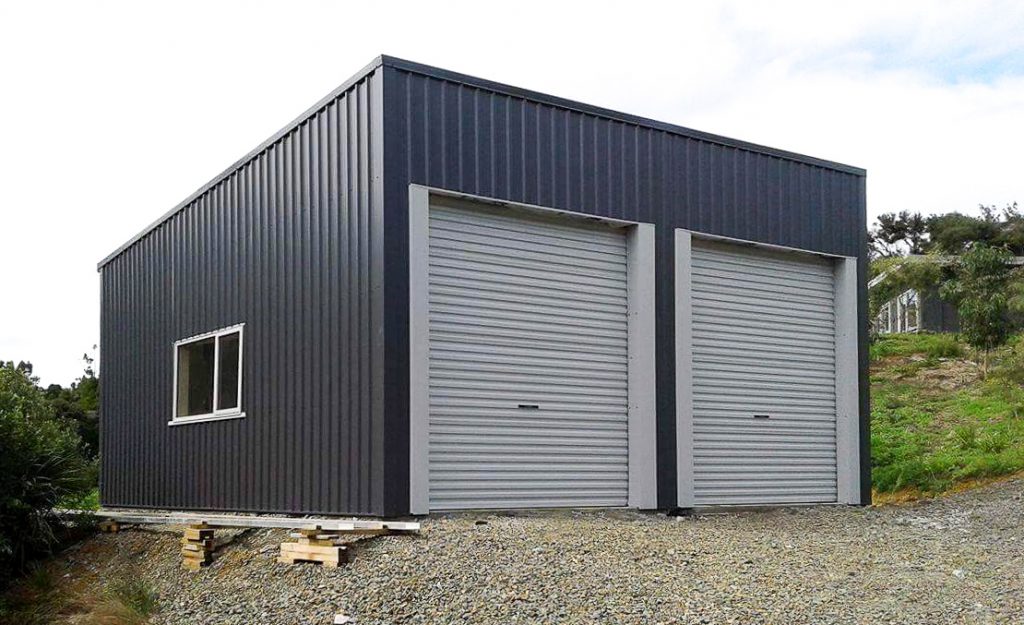
Be a detached, single-storey structure with a floor level no more than 1 metre above ground, and with a roof no higher than 4 metres at its apex.
Have a total floor area of 110m2 or less.
Have been designed or reviewed by a Chartered Professional Engineer, to make certain it complies with the NZ Building Code.
Have an unsupported roof span no greater than 6 metres. If it’s any wider, you’ll need a centre pole to remain exempt.
Be set back at least its own height from any residential building, public road, railway, or legal boundary.
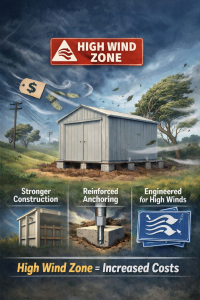
Be on a site with a wind zone no greater than ‘high’ (not exceeding 44 m/s).
Be used solely for farming activities, cannot be open to the public, and cannot store hazardous substances as defined in the Health and Safety at Work (Hazardous Substances) Regulations 2017.
Even if a building consent isn’t required, you still need to comply with district planning rules. That means checking things like site coverage, boundary setbacks, and height restrictions. Depending on your local council, resource consent may still be necessary.
Oversight
Your design must be carried out or reviewed by a Chartered Professional Engineer. Alternatively, a Licensed Building Practitioner (LBP) can carry out or supervise both the design and construction.
Other things to consider
You must ensure compliance with Building Code requirements regarding disposal of stormwater from the roof. You might need professional help with this, and council approval might be needed too.
Any future change in the use of the building (for example converting it to allow public access) requires notifying the council. This is stipulated in section 114 of the Building Act 2004.
Always check with your local council to make sure your project complies with district planning rules, such as maximum site coverage and setback regulations. Even if a building consent is not needed, a resource consent might still be required.
By rigourously following these specs and engaging with qualified professionals as and when you need to, you can be confident that your pole shed will be compliant.

Applying for a building consent exemption
This is all about making sure your shed meets all the right criteria from the get-go. Here are some great tips!
Get your design signed off by a Chartered Professional Engineer ( ask us how we can help).
Under Clause 2.6., this is non-negotiable for rural pole sheds up to 110m². The engineer must either design or thoroughly review the plans to ensure they meet the Building Code.
Get your documentation in order, including the engineer’s design or review statement, your shed’s layout plans and elevations, your site plan showing distances to boundaries, roads, and dwellings and evidence of the rural zoning from your district plan.
Here’s a peculiar thing: even though you’re asking to bypass building consent, you still need to apply for the exemption through your council. Some councils have online portals, while others may ask for a formal written request. Check with your local council and proceed accordingly.
Processing times vary from council to council but once yours has assessed that your shed meets the exemption rules, they’ll issue confirmation in writing. You should only start construction when this has happened!
Remember to hold on to all documentation, including the council’s written confirmation. You may need it later for insurance, resale, or to prove compliance if questioned.
At SHEDS4U we’ve helped countless customers with navigating these tricky waters – get in touch today and get your shed under way!
By sticking to the size limits and understanding the council process, you can avoid council consent fees and keep your project moving. And, if your shed design doesn’t meet exemption conditions, our knowledgeable inhouse team knows how to guide you through the consent process with the minimum of fuss. Call us today to discuss costs and timelines – we’re here to help!